
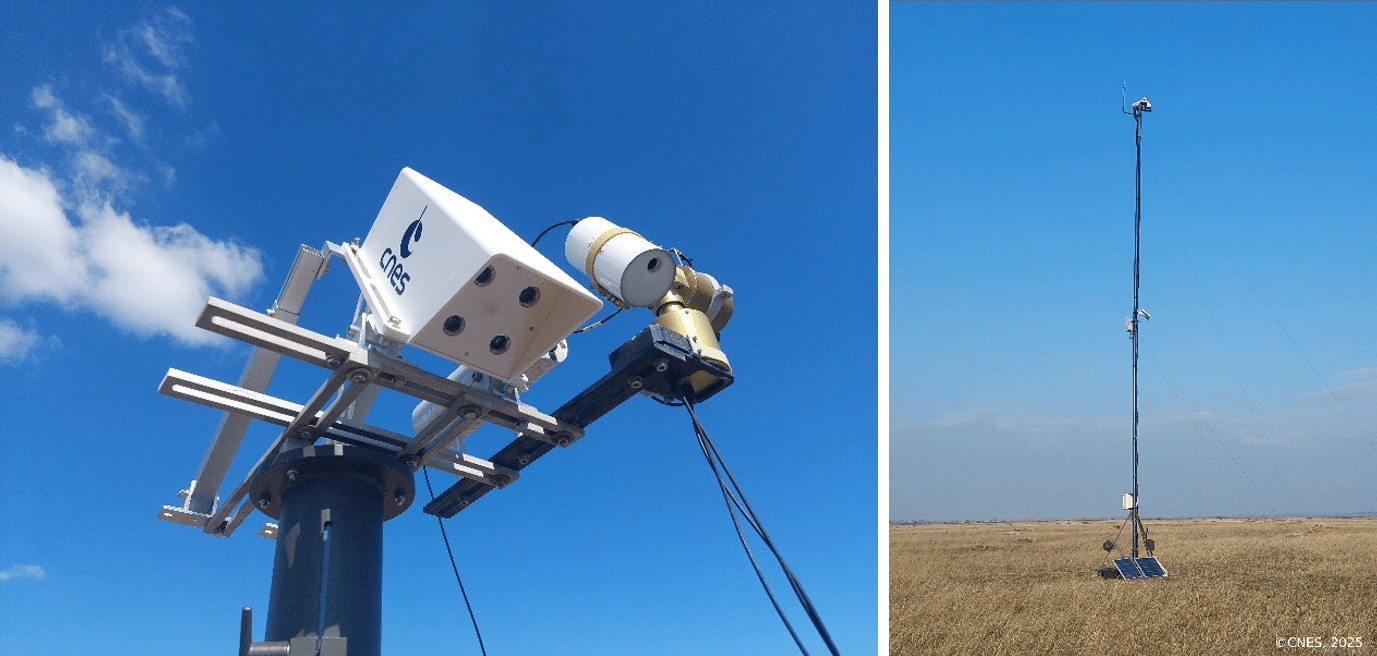
Installation of the robotized CE312 radiometer at the La Crau site for CNES
In June 2023, the new robotized version of the CE312 thermal infrared radiometer was installed on a dedicated mast at the La Crau reference site, one of CNES’s strategic Calibration and Validation (CAL/VAL) locations for current and next-generation thermal satellite missions. This installation marks a significant reinforcement of France’s long-term capability to generate the high-quality ground truth data required to validate Land Surface Temperature (LST) and surface emissivity products with scientific rigor.
The CE312 provides high radiometric accuracy, excellent thermal stability and a fine angular sampling capability that directly supports advanced thermal remote sensing applications. Its multispectral thermal channels and differential measurement principle deliver traceable radiances and brightness temperatures, forming the quantitative foundation for stringent LST product validation. The robotized head adds an essential dimension: automated multi-angle observations. These directional measurements are critical for Temperature–Emissivity Separation (TES) techniques, characterization of surface anisotropy, and the reduction of emissivity-related uncertainties that remain a long-standing challenge in comparing in situ measurements with satellite-derived LST.
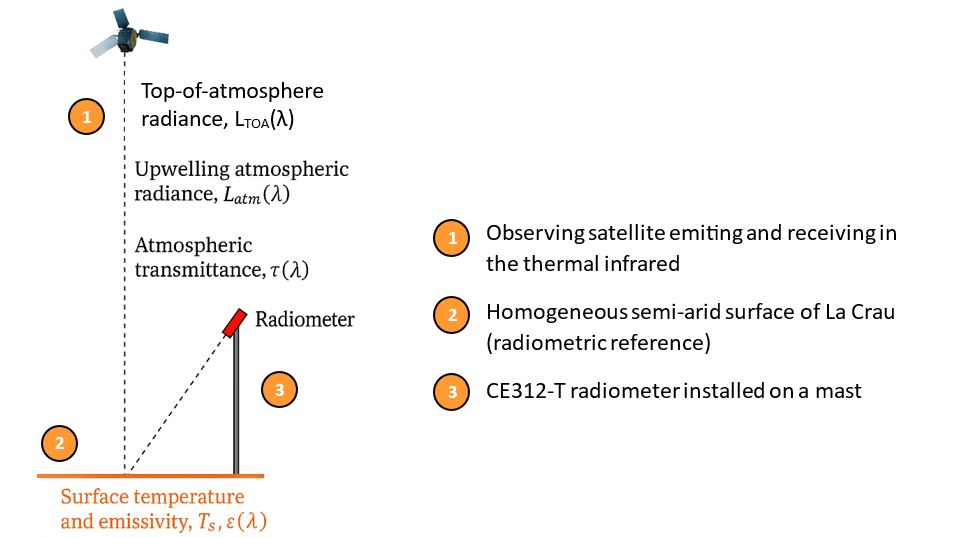
Inspired by established ground-based networks such as AERONET for aerosol optical properties and RadCalNet for surface reflectance and BRDF reference measurements, the CE312 installation extends this philosophy to the thermal domain, enabling consistent, traceable multi-angle observations of ground surfaces for enhanced satellite CAL/VAL.
Integrated into CNES’s CAL/VAL strategy, the CE312 now contributes to cross-sensor thermal product intercomparisons, supports the preparation of new missions such as TRISHNA, and provides datasets used in agriculture, hydrology and land–atmosphere energy flux modeling.
La Crau is part of the international TIRCalNet initiative, which aims to establish a harmonized network of ground reference sites for thermal infrared calibration and validation. Within this network, La Crau provides:
- Well-characterized surface temperature and emissivity measurements for generating reference top-of-atmosphere (TOA) signals.
- Traceable, stable datasets that help verify and cross-calibrate satellite radiometers.
- Multi-angle, in situ observations used to reduce LST and emissivity uncertainties and to improve algorithm robustness across missions.
TIRCalNet targets TOA brightness temperature uncertainties on the order of 0.5 K, and the CE312’s radiometric performance and robotic acquisition geometry at La Crau directly support this objective.
Since mid-2023, the CE312 has operated continuously, enhancing the long-term radiometric archive of La Crau, a semi-arid area well known for its stability and suitability for thermal infrared validation. Its directional and multispectral measurements underpin more reliable satellite LST retrievals and strengthen continuity across current and future thermal missions.